
Medical Article

Home / Medical Article / Shock Wave Therapy: A New Alternative for Treating Erectile Dysfunction

Shock Wave Therapy: A New Alternative for Treating Erectile Dysfunction

Shock Wave Therapy: A New Alternative for Treating Erectile Dysfunction

Dr.Sitt Tienthiti : Integrative and Regenerative medicine
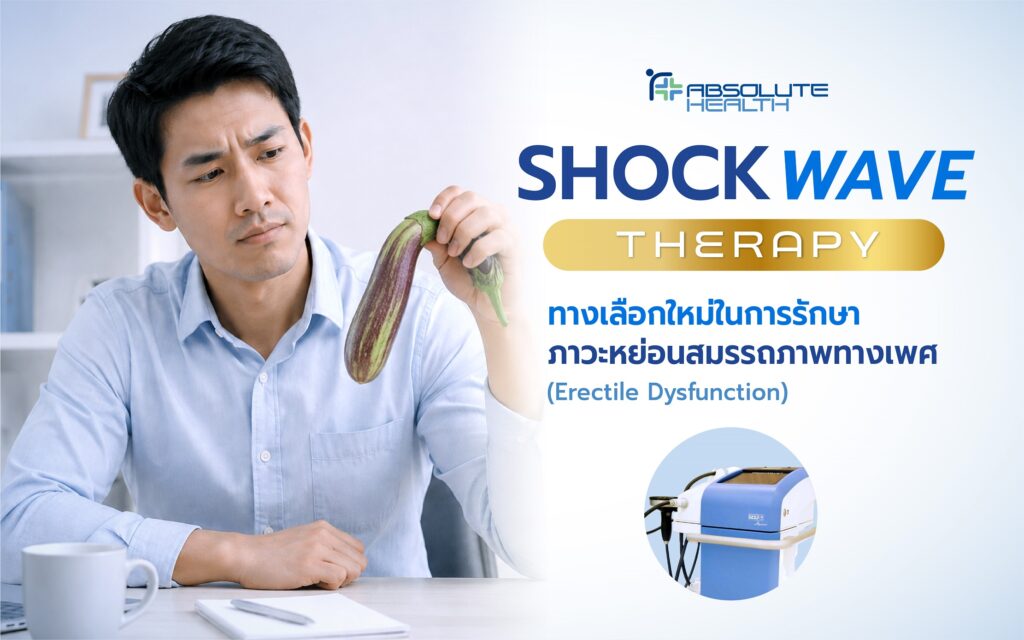
Banner ShockWave AH 01

Erectile dysfunction (ED) is a common condition among men, particularly in middle-aged and older individuals. One of the major underlying causes is impaired blood vessel function affecting blood flow to the penis, often associated with conditions such as vascular disease, diabetes, high cholesterol, or chronic stress.

Today, in addition to medications such as PDE5 inhibitors (e.g., sildenafil), which provide temporary support for erections, another increasingly recognized option is Shock Wave Therapy, also known as Low-Intensity Extracorporeal Shock Wave Therapy (Li-ESWT), a non-surgical treatment approach.

Shock Wave Therapy Erectile Dysfunction (1)

Shock Wave Therapy: Restoration Rather Than Temporary Stimulation

Shock Wave Therapy works by delivering low-intensity acoustic waves to penile tissue. These waves create controlled and safe microtrauma, which stimulates the body’s natural repair mechanisms.

The resulting effects may include:

  • Promotion of new blood vessel formation (angiogenesis)
  • Improved blood circulation
  • Restoration of endothelial function
  • Possible support for partial nerve recovery

For this reason, Shock Wave Therapy is considered a treatment aimed at “restoring the underlying cause” of ED rather than simply providing temporary symptom relief.

Shock Wave Therapy Erectile Dysfunction (2)

Medical Evidence and Clinical Outcomes

Clinical studies comparing Shock Wave Therapy with placebo treatment have shown promising results:

  • Many patients experienced significant improvement in erectile function
  • The International Index of Erectile Function (IIEF) score improved by approximately 3–4 points on average
  • Around 60–70% of patients responded positively to treatment, significantly outperforming placebo groups

Improvements are often noticeable within 1–3 months after treatment and tend to become most apparent around 6 months following therapy.

Shock Wave Therapy Erectile Dysfunction (3)

Who Benefits Most?

This restorative approach appears to work best in patients with:

  • Mild to moderate erectile dysfunction
  • Vasculogenic ED (ED caused primarily by vascular problems)
  • Early-stage vascular deterioration
  • Partial or inadequate response to ED medications

However, treatment outcomes may be less favorable in:

  • Patients with severe ED
  • Long-standing diabetes with advanced vascular damage
  • Cases primarily caused by neurological or psychological factors

Key Advantages of Shock Wave Therapy for ED

  • Non-surgical treatment
  • No medication required
  • Very few side effects, typically limited to mild tightness or temporary irritation

When performed by experienced physicians, Shock Wave Therapy is generally considered a safe treatment option.

Shock Wave Therapy Erectile Dysfunction (4)

Important Considerations

Although encouraging results have been observed in selected patient groups, several limitations remain:

  • There is currently no universally standardized treatment protocol across studies
  • Long-term data beyond one year remain limited
  • Shock Wave Therapy is not considered a first-line standard treatment in current international guidelines

Therefore, Shock Wave Therapy for erectile dysfunction is generally regarded as an adjunctive or supportive treatment rather than a primary standalone therapy. It may serve as a valuable tool in the restoration process, but it is not a complete solution by itself.

While Shock Wave Therapy may help restore vascular function, long-term success also depends on addressing the root causes of ED, including:

  • Diabetes
  • High cholesterol
  • Hypertension
  • Smoking
  • Sleep deprivation
  • Chronic stress

Without proper management of these contributing factors, treatment results may not be sustainable over time.

Shock Wave Therapy is therefore considered a promising option for patients with erectile dysfunction, particularly during the early stages of the condition, because it focuses on “restoration” rather than merely providing “temporary stimulation.”

However, the most effective long-term outcomes still require comprehensive health management, because truly successful treatment is not simply about improving symptoms today, but about maintaining lasting improvement in the future.

  1. Clavijo RI, Kohn TP, Kohn JR, Ramasamy R. Effects of low-intensity extracorporeal shockwave therapy on erectile dysfunction: a systematic review and meta-analysis. J Sex Med. 2017;14(1):27–35.
  2. Lu Z, Lin G, Reed-Maldonado A, Wang C, Lee YC, Lue TF. Low-intensity extracorporeal shock wave treatment improves erectile function: a systematic review and meta-analysis. Eur Urol. 2017;71(2):223–233.
  3. Dong L, Chang D, Zhang X, Li J, Yang F, Tan K, et al. Effect of low-intensity extracorporeal shock wave therapy on erectile dysfunction: a systematic review and meta-analysis. Urology. 2019;126:104–112.
  4. Man L, Li G. Low-intensity extracorporeal shock wave therapy for erectile dysfunction: a systematic review and meta-analysis. Urology. 2018;119:97–103.
  5. Campbell JD, Trock BJ, Oppenheim AR, Anastos H, Burnett AL. Meta-analysis of randomized controlled trials that assess the efficacy of low-intensity shockwave therapy for the treatment of erectile dysfunction. Ther Adv Urol. 2019;11:1756287219838364.
  6. Sokolakis I, Dimitriadis F, Teo P, Hatzichristodoulou G. Clinical outcomes of low-intensity shockwave therapy for erectile dysfunction: a systematic review and meta-analysis. Sex Med Rev. 2019;7(3):343–354.
  7. Yao C, Peng C, Wang Z, Li H, Wu J, Zhou L. Efficacy of low-intensity extracorporeal shockwave therapy in erectile dysfunction: a meta-analysis of randomized controlled trials. Int J Impot Res. 2022;34(3):223–232.
  8. Vardi Y, Appel B, Kilchevsky A, Gruenwald I. Does low intensity extracorporeal shockwave therapy have a physiological effect on erectile function? Short-term results of a randomized, double-blind, sham-controlled study. J Urol. 2012;187(5):1769–1775.
  9. Olsen AB, Persiani M, Boie S, Hanna M, Lund L. Can low-intensity extracorporeal shockwave therapy improve erectile dysfunction? A prospective, randomized, double-blind, sham-controlled study. Scand J Urol. 2015;49(4):329–333.
  10. Fojecki GL, Tiessen S, Osther PJ. Effect of low-energy linear shockwave therapy on erectile dysfunction—A double-blind, sham-controlled, randomized clinical trial. J Sex Med. 2017;14(1):106–112.
  11. Kitrey ND, Gruenwald I, Appel B, Vardi Y. Penile low-intensity shock wave treatment is able to shift PDE5i nonresponders to responders: a double-blind, sham-controlled study. J Urol. 2016;195(5):1550–1555.
  12. European Association of Urology. EAU Guidelines on Sexual and Reproductive Health. Arnhem: EAU Guidelines Office; 2024.
  13. Burnett AL, Nehra A, Breau RH, Culkin DJ, Faraday MM, Hakim LS, et al. Erectile dysfunction: AUA guideline. J Urol. 2018;200(3):633–641.
  14. Salonia A, Bettocchi C, Carvalho J, Corona G, Jones TH, Kadioglu A, et al. EAU guidelines on sexual and reproductive health—2021 update. Eur Urol. 2021;80(3):333–357.
  15. Qiu X, Lin G, Xin Z, Ferretti L, Zhang H, Lue TF, et al. Effects of low-energy shockwave therapy on the erectile function and tissue of a diabetic rat model. J Sex Med. 2013;10(3):738–746.
  16. Liu J, Zhou F, Li G, Wang L, Li H, Zhou L. Evaluation of low-intensity extracorporeal shock wave therapy for erectile dysfunction in a rat model. BJU Int. 2013;112(3):E189–E195.
  17. Wang CJ. An overview of shock wave therapy in musculoskeletal disorders. Chang Gung Med J. 2003;26(4):220–232.
  18. Gruenwald I, Appel B, Kitrey ND, Vardi Y. Shockwave treatment of erectile dysfunction. Ther Adv Urol. 2013;5(2):95–99.
  19. Hatzichristodoulou G. Low-intensity shockwave therapy for erectile dysfunction: is the evidence strong enough? Nat Rev Urol. 2021;18(10):593–594.
  20. Sokolakis I, Hatzichristodoulou G. Clinical studies on shockwave therapy for erectile dysfunction: a systematic review. Sex Med Rev. 2023;11(1):104–115.
  21. Chung E, Wang J. A state-of-art review on low intensity extracorporeal shock wave therapy and erectile dysfunction. Expert Rev Med Devices. 2017;14(11):929–934.